Loading…
MII
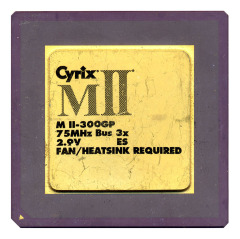
Launched in 1998The Cyrix MII is essentially a later commercial branding and refinement of the 6x86MX, introduced after Cyrix’s acquisition by National Semiconductor, and built around the same M2-derived Socket 7 microarchitecture with dual-issue superscalar execution, register renaming, out-of-order instruction handling, and translation of x86 instructions into simpler internal operations. It preserves full IA-32 compatibility, MMX support, and the large 64 KiB unified L1 cache that remained one of its main technical strengths, delivering strong integer performance per clock in office and general-purpose workloads, but like the 6x86MX it continued to suffer from a comparatively weak floating-point unit and relatively high power dissipation. Although marketed with performance ratings rather than raw clock speed to compete with Intel and AMD offerings, the MII remained fundamentally constrained by the aging Socket 7 platform, limited bus scaling, and increasing competitive pressure from newer superscalar designs such as the Pentium II and AMD K6-2. Technically, the MII is best understood not as a new architecture but as the final, highest-clocked commercial form of Cyrix’s 6x86MX lineage.